Segment A Type fonts from Kobuzan - (cgoin)

Segment A Type
Segment A Type Segment A TypeSegment A Type


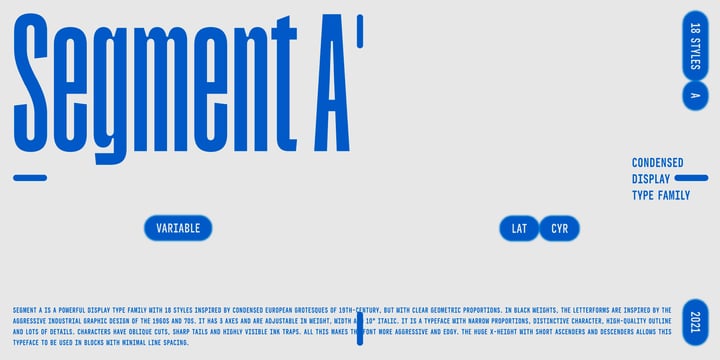
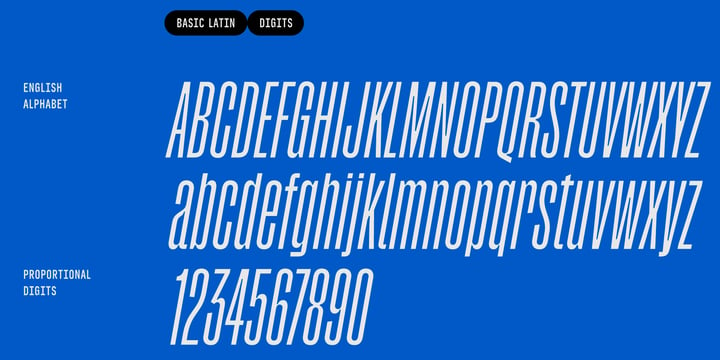
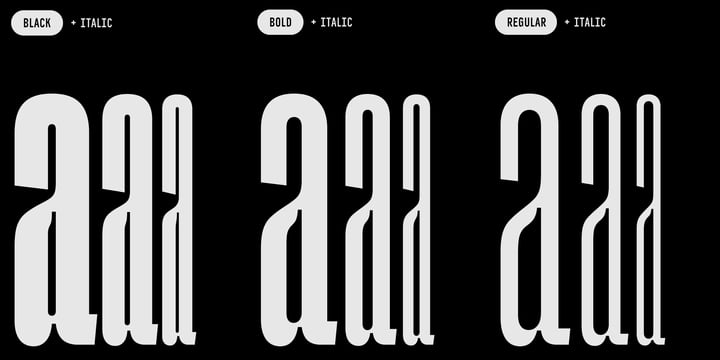
Segment A is a powerful display type family with 18 styles inspired by condensed European grotesques of 19th-century, but with clear geometric proportions. In Black weights, the letterforms are inspired by the aggressive industrial graphic design of the 1960s and 70s. Both have 3 axes and are adjustable in weight, width and 10˚ italic. It is a typeface with narrow proportions, distinctive character, high-quality outline and lots of details. Characters have oblique cuts, sharp tails and highly visible ink traps. All this makes the font more aggressive and edgy. The huge x-height with short ascenders and descenders allows this typeface to be used in blocks with minimal line spacing.


Features:


– Total glyph set: 631 glyphs;

– 18 styles (3 weights x 3 widths + italic);

– Support 210+ languages;

– Latin Extended;

– Cyrillic Basic + Bulgarian letters;


OpenType features:


– Proportional numerals, tabular numerals, superiors, fractions;

– Punctuations and symbols;

– Arrows;

– Stylistic alternates (ss01-ss05);

– Ligatures;

– Case-sensitive forms.


Popular posts from this blog

Sablon fonts from Roman Černohous - (uqzdm)

Sablon Solid all caps display font with a hint of retro expression. Wide language support including complete set of Cyrillic characters. Sablon Download Now View Gallery

[jyivg] Download Bradbury Five fonts from Device

Bradbury Five A stylish cartoon sans reminiscent of lettering by Harvey Kurtzman on early issues of Mad, or other casual mid-century types. The three widths give full versatility for expressive, customised headlines and layouts, while the lighter weights can be used for text. Conveys an approachable, light touch with style and finesse. Bradbury Five Download Now View Gallery

Plethora fonts from Sudtipos - (wkpml)

Plethora A few years ago I've discovered the work of one of the most prolific typeface designers of the Bruce type Foundry in NYC during late nineteenth century. Browsing Julius Herriet's work I found a very unique kind of ligatures in his patented "Old Style Ornamented" type design. Some letters were designed with a little top tail that allowed them to connect to each other. After that, I found that he also designed a single italic weight of the same font 7 years later.  Since the beginning of the Opentype days I’ve been deeply obsessed with exploring different ways to build ligatures, so that lead me up to this point where I felt the need to create “ Plethora ”, this new font inspired by Herriet’s work. Extrapolating weights, adding variable technology and playing with additional interconnected letters and alternates. Definitely, Plethora means a large or excessive amount of something, and this font tries to bring back this abundance of details two centuries ...